• Home
  • About This Blog
  • Contact Me
  • Subscribe
  • Comment Policy

Attempts at Honesty

Reflections on the interplay of the Bible and Culture

  • Westminster Shorter Catechism Series
  • Sermon on the Mount Series
Home Archives for Bible Reflection

The God of new beginnings and second chances

Posted on March 1, 2012 Written by Mark McIntyre Leave a Comment

Second ChanceFailure is a part of daily life. The best we can do is to keep the failures small, but  failures they are none-the-less.

The question is not whether we will fail, but how we will respond to failure.

Every motivational speaker will tell you that the best way to respond to failure is to pick yourself up and keep moving. Learn from the failure and move forward. There is some truth to this. Yet our moral failures require more than just getting up and trying again.

Even a casual reading of the Sermon on the Mount will provide the understanding that from God’s point of view, sin is an internal process that sometimes works it’s way into outward behavior. The sin of lust can sometimes lead to adultery. Inappropriate anger can sometimes lead to murder. The moral failure happens before the external action.

The Bible records the colossal failures of some of the heroes of the faith. Abraham twice lied about his wife and nearly caused international incidents on both occasions. Isaac perpetrated the same lie about his wife with similar result. David committed adultery and covered it up with murder. Peter denied Jesus three times. Paul began his career as a bounty hunter bringing Christians to persecution and death.

All of these men, like us, have experienced failure. They each have also experienced forgiveness and restoration. They were in relationship with the God of second chances. God promises to forgive when we confess and repent (1 John 1:9).

The restoration of Peter in John chapter 21 is illustrative of this. Not only did Jesus restore Peter to fellowship, he gave him a ministry of caring for the church that was about to be born. Tend my lambs is what Jesus commanded Peter to do. Jesus did not excuse Peter’s behavior but gave him the opportunity to move beyond it. Not only did he get to move beyond it, he was also able to be a key figure in the growth of the early church.

I should point out that the major difference between the Peter of the courtyard (Matthew 26:69-75) and Peter the street preacher (Acts 2:14 ff) is that the Holy Spirit came upon the disciples (including Peter) and empowered them for ministry.

God uses our failures to help us to learn humility and dependence upon him. This humility and dependence is the foundation on which the ministry can then be built. Perhaps failure is the only sure path to humility.

Since our God is the God of second chances and he has given us the opportunity for restoration, we need to be the people of second chances. Being the knuckleheads we sometimes are, we are bound to hurt each other. When this happens we need to forgive as Paul instructs to do in Ephesians 4:32 which reads, “Be kind to one another, tender-hearted, forgiving each other, just as God in Christ also has forgiven you.” We are to forgive as we have been forgiven.

Too often in the church, people are labeled as a result of some event in their lives and not allowed to recover from that failure. Unfortunately there is some truth in the criticism that the “church is the only organization that shoots its wounded.”

There is nothing so heinous that cannot be forgiven by God and we should not be slow to practice that same forgiveness. My guess is that if we did a better job of forgiving, our stress level would go down and our church attendance would go up.

Filed Under: Bible Reflection Tagged With: Abraham, Christ, forgiveness, God, Gospel of Matthew, Holy Spirit, Jesus, Peter

Toward being a peacemaker

Posted on February 28, 2012 Written by Mark McIntyre Leave a Comment

Toward being a peacemaker – #11 in the Sermon on the Mount Series

Blessed are the peacemakers

Peacemakers

According to the Bible, human history began in peace and will end in peace. The middle part has been a little rough.

John Lennon asked us to give peace a chance, but how can we do this? Even if you define peace as the absence of war, humanity does not have a very good track record. According to Will Durant, out of 3421 years of documented history, there were only 268 years without war at the time of his writing. That means that roughly 92.2% of the time, some part of the globe was in open hostility. With the rise of Islamic unrest in the Middle East, this percentage is likely to rise rather than fall. Human history cannot bear out any assertion that man is capable of producing peace, John Lennon notwithstanding.

To be a peacemaker first requires that one be at peace. Even Muddy Waters knows that you can’t give away “what you ain’t never had.” Man has not been at peace since our initial rebellion against God as recorded in Genesis 3. Beginning with that initial rebellion, man has been at war with God, his neighbors, his world and himself. The external conflict is a product of the conflict within. Until that internal conflict is resolved, there is no chance of anything better than a superficial peace.

Paul tells us in Romans 5:1 that the path to peace with God is through Jesus Christ. It is by being justified by faith in Jesus that peace can be obtained. This is the first step to being a peacemaker in the sense that Jesus presents in Matthew 5:9.

In 2 Corinthians 13:11 Paul tells us to “rejoice, be made complete, be comforted, be like-minded, live in peace; and the God of love and peace will be with you.” Elsewhere Paul tells us to live in peace with one another (1 Thess. 5:13).

If we accept God’s provision in Jesus Christ for fixing the vertical relationship with God, it will then allow us to work on the horizontal relationships with our neighbors. I do not think that it is possible to over emphasize the two Great Commands that Jesus catalogs in Matthew 22:37-40. Love God; love your neighbor. They must be done in that order.

It seems obvious, in light of these verses that a peacemaker cannot be self-focused. I am not at peace with God or my neighbor when I am focused on my wants, my needs or even my rights. A true peacemaker is one who surrenders to God and trusts in him.

A peacemaker is one who is redeemed and justified by faith in Jesus Christ, who is actively developing his relationship with God and who is actively seeking to share that relationship with those around him. A peacemaker is one who takes seriously the call of Jesus to make disciples in Matthew 28:19-20. For it is only as a disciple that I can begin to know peace.

They will be called children of God

Paul tells us in Romans 8:14 that all who are being led by the Spirit of God, are sons of God. The author of Hebrews tells us that God disciplines us as sons (Hebrews 12:7).

By being in relationship with God through Jesus Christ, we are adopted into God’s family. We have become sons and daughters and will be treated as such. This verse emphasizes that one of the hallmarks of a son or daughter of God is that he or she will have a legacy of peacemaking. When we are at the end and stand before Jesus, we should be able to hear him point to that legacy as evidence of our relationship with him.

A call to action

Even as I write this, I am convicted that I do not take every opportunity to be a peacemaker that is presented to me. I am often self-focused, insensitive or insecure. To be a peacemaker, I should have a strong desire to share the good news of Jesus Christ with anyone who hasn’t heard it.

Not only does our peacemaking have a passive component, it should have an active component also. Let’s make it active and see what happens to our churches and our communities.

Filed Under: Bible Reflection Tagged With: God, Jesus, Jesus Christ

Toward the conquest of fear

Posted on February 18, 2012 Written by Mark McIntyre Leave a Comment

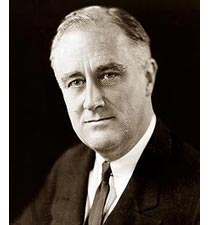
We have nothing to fear - FDR

In his first inaugural address, Franklin D. Roosevelt used the oft quoted phrase, “the only thing we have to fear is fear itself.” The first time I heard this quotation, I thought it rather silly since there are many things to fear. But as I’ve gotten older (I hesitate to say matured), I see the wisdom in this.

In the New Testament, the verb phobeo (fear) is used as an imperative 62 times (list).  If I counted correctly, 59 of those instances the command is used in the negative; we are commanded to not fear. In the 3 remaining uses of phobeo we are commanded to fear God.

Why does God tells us so many time to not fear? It is because we are prone to experiencing fear. Fear is a powerful, if short term, motivator. Since it is so powerful and since we have an enemy, it should not surprise us that The Enemy uses fear as one of the primary weapons in his arsenal. That is why Peter tells us to “Be of sober spirit, be on the alert. Your adversary, the devil, prowls around like a roaring lion, seeking someone to devour.” (1 Peter 5:8)

In this election year we see fear used as a campaign tool. The ads tell you about all the bad things that will happen to you if you elect the other guy. Political commentators make a lucrative income by playing to these fears. We as believers must not give in to them. We can’t panic. God has not given up control.

In 1 John 5:4 we are told that our faith is able to conquer the world. That faith is rooted in an understanding of the nature of God. We can be confident in God’s ability to remain in control and complete his plan for the world. His love and justice will not be thwarted by any scheme of the enemy.

If that is the case, then why do we fear?

I am not a trained counselor so you may think my answer to this question is simplistic. If so, I ask your pardon. Yet I have a sense that we fear because we do not understand nor appropriate God’s love and power. The Apostle Paul proclaimed this great love for us when he penned these words:

“But God, being rich in mercy, because of His great love with which He loved us, even when we were dead in our transgressions, made us alive together with Christ (by grace you have been saved), and raised us up with Him, and seated us with Him in the heavenly places in Christ Jesus, so that in the ages to come He might show the surpassing riches of His grace in kindness toward us in Christ Jesus. For by grace you have been saved through faith; and that not of yourselves, it is the gift of God; not as a result of works, so that no one may boast.” (Ephesians 2:4–9, NASB95)

God made us alive, raised us up and seated us with Jesus Christ. By his resurrection, Jesus displayed his destruction of the most powerful source of fear that the Enemy has, that is death.

So I must remind myself, if Jesus has conquered death, what could be worse than that? If God is master over death, can he not get me through whatever trial that comes my way? Yes he can. I simply need to live as though this is true despite what my fears tell me.

Filed Under: Bible Reflection Tagged With: Apostle Paul, Christ, Christ Jesus, God, Jesus, New Testament

Under Construction: New Blog Theme for Attempts at Honesty

Posted on February 14, 2012 Written by Mark McIntyre Leave a Comment

Under ConstructionPlease be patient over the next few days/weeks as Attempts at Honesty is under construction. We have installed the Pagelines Theme which needs to be customized. If you see features that you like or don’t like, please comment and we’ll take your input into consideration.

The good news is that this theme is very customizable and has a lot of features. The bad news is that customization takes time and I’m learning what the features are and how they might enhance the reading experience of the blog. So, it will be trial and error, tweaking a little here, a little there.

Thanks for your understanding and patience.

-Mark

Filed Under: Bible Reflection Tagged With: Disqus, wordpress

  • « Previous Page
  • 1
  • …
  • 118
  • 119
  • 120
  • 121
  • 122
  • …
  • 150
  • Next Page »

Follow Attempts at Honesty

Honesty in your Inbox

Post Series

  • Westminster Shorter Catechism Series
  • Sermon on the Mount Series
January 2026
SMTWTFS
 123
45678910
11121314151617
18192021222324
25262728293031
« Dec    

Categories

Archives

Blogger Grid
Follow me on Blogarama

Copyright © 2026 · Focus Pro Theme on Genesis Framework · WordPress · Log in