• Home
  • About This Blog
  • Contact Me
  • Subscribe
  • Comment Policy

Attempts at Honesty

Reflections on the interplay of the Bible and Culture

  • Westminster Shorter Catechism Series
  • Sermon on the Mount Series
Home Archives for 2012

Archives for 2012

Truth is an arrow and the gate is narrow

Posted on July 18, 2012 Written by Mark McIntyre 6 Comments

The Culture

Over the last week or so, I’ve tweeted about several stories regarding proposed or approved concessions that the “main line” denominations would make to the prevailing culture. For example is this one:

They wonder why people are leaving?: Rev. Emily C. Heath: The Religious Right (Side of History) http://t.co/mNxyCt69

— Mark McIntyre (@mhmcintyre) July 16, 2012

As Rev. Emily Heath writes in that article:

For Christians in the mainline Protestant denominations, this has been an interesting summer. First, the Presbyterian Church (USA) rejected an amendment that would have opened the church up to blessing same-sex marriages. Then, less than a week later, the Episcopal Church approved a new liturgy to bless same-sex unions and also affirmed the ministry of transgender clergy.

The PCUSA rejection of that amendment was a narrow victory for those who desire to stay true to Scripture.

The Truth

While Rev. Heath and others are euphoric over these monumental changes. I am reminded of Jesus’ words in Matthew 7:

“Enter through the narrow gate; for the gate is wide and the way is broad that leads to destruction, and there are many who enter through it. “For the gate is small and the way is narrow that leads to life, and there are few who find it.” (Matthew 7:13–14, NASB)

Truth is Narrow
Image via freefoto.com

Truth, is by its very nature narrow. The description of an object is always narrow as compared to what it is not. I have on my wrist a watch, it is not a hammer or a motorcycle or a puppy or a yacht. It is one thing and there are an infinite number of things it is not.

When the New Testament uses the word homosexual, the Greek word from which it is translated is a very graphic term which describes a sex act between men. You can work around this all that you want, but it is the homosexual act that is condemned. The word means one thing and no amount of wrangling of words can make it mean something different. The definition is narrow and specific.

Furthermore, Jesus himself tells us that marriage is between a man and a woman. According to Jesus, it is for the purpose of being married to a woman that a man will leave his father and mother.

Some would see support for homosexual union in an argument from silence because Jesus does not specifically speak against same sex pairing. Yet I would argue that the silence cuts the other way because Jesus specifically identifies a union between a man and a woman as the relationship that God ordains and God blesses. Nowhere can you find any such blessing for a homosexual union. So the argument that Jesus was silent on homosexuality is a sham.

The definition of marriage is narrow. I understand that for those with same sex attraction, this is very difficult. Yet, the difficulty does not relieve us of the burden of proclaiming the truth.

All sin is condemned in Scripture. For example, the Bible condemns religious pride. Those of us who have grown up in the church can look down on others who have less knowledge of Scripture and Christian principles. Scripture condemns this pride and I am wrong when I practice it. When I am proud, no excuse or explanation will make that pride less wrong.

We cannot lightly set aside the clear teaching of Scripture just because we have a desire and a  proclivity toward a certain behavior. Whether it be pride or homosexuality, we cannot aquiesce into acceptance no matter how much pressure there is from inside and outside the church.

The Gate

As Bob Dylan so eloquently tells us, “Truth is an arrow and the gate is narrow that it passes through.”

The Truth hurts all of us, but the wound is ultimately for our benefit if we are willing to yield.

Filed Under: Bible Reflection, Christianity and Culture Tagged With: Church, Culture, homosexuality, Truth

What is that to you? – A lesson from C. S. Lewis

Posted on July 16, 2012 Written by Mark McIntyre 1 Comment

The C. S. Lewis Quote

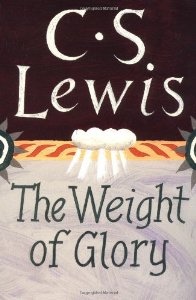
The Weight of GloryWalter Hooper writes this anecdote in his introduction to The Weight of Glory about an interaction he had with C. S. Lewis:

‘I told Lewis that I was tempted – very strongly tempted – to tell Our Lord that I thought it monstrously unfair that He should allow the naughty old atheist to seemingly go on forever and yet let Lewis, who was only sixty-four, come so close to the point of death. ‘Mind you,’ I said, observing Lewis’s face cloud over, ‘I haven’t actually said it in my prayers, but I’ve come pretty close.’

And what do you think our Lord would say to that?’ Lewis said with a discouraging look.

‘What?’

‘What is that to you!’

Anyone who had read John 21:22 – Our Lord’s rebuke to St. Peter – will recognise Lewis’ application of it in this instance.

Mr. Hooper goes on to write that Lewis would do what he could to improve a situation but trust the outcome to God. Once he had trusted it to God, Lewis would not give it another thought. In other words, Lewis had a good sense of boundaries and where his responsibility was at an end.

The Lesson

This is a lesson that I struggle to learn. Too often I stew about things over which I have no control. Sometimes it goes beyond stewing and I try to affect change in a situation where my input is not required or wanted. I should have already learned this lesson because it always goes badly when I go beyond the boundary.

At it’s core, my inability to know my boundaries stems from a lack of faith in God. I lack faith either because I distrust God’s goodness or I doubt his desire to make this situation right. When I worry about thongs which are beyond my control I show the weakness of my faith.

“What is that to you?” is the correct question to ask.

If God allows a bad situation that is beyond my ability to fix, what is that to me? If someone else gets a reward or position that he did not deserve, what is that to me? If a candidate for whom I did not vote gets into office, what is that to me? If someone says something about me that is not true, what is that to me?

Paul tells us in Philippians 1:6 that God will complete what he has started. We also learn from Paul’s experience of the thorn in the flesh that God uses circumstances to teach us what we need to learn to progress in holiness.

Do I really trust God or do I merely pay him lip service? When I try to affect change outside of my God given sphere of  responsibility, then I prove that I am doing the latter.

Filed Under: Bible Reflection Tagged With: Christianity, God, Lewis, Weight of Glory

Numbering our days: a reflection on Psalm 90

Posted on July 14, 2012 Written by Mark McIntyre 1 Comment

Beyond a temporal understanding

Number our daysI have been reading through the Psalms. Recently I came to Psalm 90 where it says, “So teach us to number our days, that we may present to you a heart of wisdom.” (Psalm 90:12) This is a verse that has often been quoted, usually in the sense of expressing urgency to get busy in doing work for the Kingdom of God. In this understanding, the emphasis is on the fleeting nature of time and how we have, on average, some 70 years to accomplish things for God before life comes to an end.

If this is the correct understanding of this verse, wisdom would dictate that we discover our calling and work hard at accomplishing the most in the time we have allotted. Ephesians 5:15-16 would seem to support this understanding when Paul writes:

Therefore be careful how you walk, not as unwise men but as wise, making the most of your time, because the days are evil.

I have even heard it said that we should keep a running countdown of the days until our 70th birthday so that we can be aware of how much time we have left to work for the Kingdom. While the countdown is not a bad idea, I think that it does not capture the whole point of the prayer in the context of the Psalm. Awareness of the brevity of our days has benefit, but the focus should not be on what we plan on accomplishing but upon what God wants to accomplish through us.

Obedience is the key

Moving a few verses back in the Psalm, it can be seen that the context of the prayer is God’s judgment against Israel for their rebellion. In verse 8 it says, “You have placed our iniquities before You, our secret sins in the light of Your presence.” In other words we are to live with the understanding that we are under the scrutiny of God and as a result, we must have an understanding of our finite nature and respond to God properly. It is not our temporal awareness that is in question, but our ability to obey.

In reading the rest of the Psalm I have a sense that some of the anger at the nation of Israel was due to presumption on their part. They presumed upon God’s tolerance and as a result they reaped God’s anger. Can we not do the same? We can be busy doing all sorts of things and convince ourselves that we are doing it for God. Jesus often rebuked the Pharisees for this type of hypocrisy. The question is not whether we are busy, the question is are we being responsive to God?

On the basis of this, I see Psalm 90:12 as a request to help us understand our finiteness rather than an encouragement to pack in as much in our 70 years as possible. The lesson we learn from Matthew 7:21-23 is that activity is not the cause for reward, relationship with Jesus Christ is. This prayer is not a call to busyness or activity, it is a call to submission to God.

It is God’s plan

I do not for a minute buy into the argument that there is something that God needs me to do and I am the only one to do it. Yes, God allows me to participate in the accomplishment of his will but my rebellion or incompetence cannot derail his plan. I do not have to race the clock to get something accomplished for God. This is freeing if I allow it to be.

What I do need to do is bring my finite understanding to God and seek him for what I should be about today. Do we really believe Jesus when he said take not thought for tomorrow? I don’t need to plan out what I need to accomplish for God, I need to do what he has asked me to do today. God will take care of the years moving forward if I simply submit each day to him.

Filed Under: Bible Reflection Tagged With: Christianity, God, hypocrisy, Israel, Israelites, Jesus, Jesus Christ, obedience, psalm

You reap what you sow – values and the criminal element

Posted on July 12, 2012 Written by Mark McIntyre 1 Comment

Apple with worm holeThis post is not about politics. It involves a politician who made an appeal to the values of the gangs in his city. The philosophy behind the statements is in need of comment.

Rahm Emanuel recently made statements regarding the gang violence in the city in which he serves as mayor. In those statements, he suggested to the gang members that they should “take your stuff away to the alley.” The New York Post quotes Emanuel as saying, “It’s not about the crime. It’s about values,” in response to the recent high-profile gang shooting of a 7-year-old girl killed in the crossfire as she sold candy outside her home.

For me, these statements are a classic example of what the Apostle Paul wrote in Romans 1:22, “Professing to be wise, they became fools.”

They are criminals

First, Mr. Emanuel is addressing criminals. The very nature of a criminal is that he does not recognize the boundaries that God or society have put in place to maintain an orderly civilization. On what basis does he appeal to the gangs to change their behavior? If they recognized the authority of the police and the government, they would not be criminals and would not be killing people. To ask them to have values is almost as silly as asking my dog to become a bunny or a giraffe. Without a change in their hearts and minds to the point where they recognize a higher authority, no appeal to them will be effective.

Criminals do not share our values

Secondly, on what basis should the gang member value one life over another? Why should the gangster be concerned about the little girl? I’m agreement that he should be concerned about her, but considering that he shows no aversion to shooting people and selling drugs or whatever else his gang does, it does not seem likely that when the opportunity comes to strike at his enemy, rational evaluation will prevent him from pulling the trigger.

Society has contributed to the problem

Our country is becoming increasingly atheistic, to the point that anyone who dares teach transcendent values to children is considered dangerous or kooky. We teach kids in school that they are the product of random mutations. We teach them that the strong will outlive the weak and then we get upset when they put that philosophy into practice.

Similarly, we send the best and the brightest to Ivy League schools where they are taught that there are no objective moral standards. They are taught that morality cannot be legislated; they are free to live as they want with no restrictions. Yet when they become executives and live out this philosophy in the board room, we put them in jail for circumventing the financial regulations.

The party affiliation of Rahm Emanuel has nothing to do with this gaffe. The philosophy and the spirit of our age that he has knowingly or unknowingly ingested have everything to do with it. The idea that children should be free to choose their own belief system is now showing itself to be a delusion at best and a nightmare at worst. It is not a question of whether children will be indoctrinated; it is a question of what will be included in that indoctrination.

We are reaping what we have sown

We are reaping the fruit we planted when we threw off the moral categories on which the country was founded. The apple of freedom that looked so appealing when we first saw it has been found to be full of worms.

Filed Under: Bible Reflection Tagged With: crime, God

  • « Previous Page
  • 1
  • …
  • 12
  • 13
  • 14
  • 15
  • 16
  • …
  • 33
  • Next Page »

Follow Attempts at Honesty

Honesty in your Inbox

Post Series

  • Westminster Shorter Catechism Series
  • Sermon on the Mount Series
December 2025
SMTWTFS
 123456
78910111213
14151617181920
21222324252627
28293031 
« Nov    

Categories

Archives

Blogger Grid
Follow me on Blogarama

Copyright © 2025 · Focus Pro Theme on Genesis Framework · WordPress · Log in