• Home
  • About This Blog
  • Contact Me
  • Subscribe
  • Comment Policy

Attempts at Honesty

Reflections on the interplay of the Bible and Culture

  • Westminster Shorter Catechism Series
  • Sermon on the Mount Series
Home Archives for Bible Reflection

Crowds and compassion

Posted on July 24, 2012 Written by Mark McIntyre Leave a Comment

The Crowd

Jesus, seeing a crowd of people had compassion on them. Mark sets the scene in the opening verses of Chapter 8:

“In those days, when there was again a large crowd and they had nothing to eat, Jesus called His disciples and said to them, “I feel compassion for the people because they have remained with Me now three days and have nothing to eat. “If I send them away hungry to their homes, they will faint on the way; and some of them have come from a great distance.”” (Mark 8:1–3, NASB)

The Physical Need

Crowd
Photo credit: brixton

There are two needs of which Jesus is aware concerning the crowd. The first one is that the crowd had nothing to eat and had been following Jesus for three days.

It is likely that many of the people were hungry when they began following Jesus and they were hungrier still after three days. There was a very real and very urgent need for food.

The danger we have as the church in North America is that we can assume that the government will take care of the needs of the people around us. After all, we might argue, isn’t that why we pay taxes?

While programs for the needy may be a staple of 21st Century politics, there are still great needs that we can meet if we only open our eyes to see them. Like the disciples, we sometimes need someone to point out the opportunities because we are often conditioned to look past them.

When we see a crowd, too often we see an inconvenience. Jesus saw the crowd as an opportunity. In this particular case, it was an opportunity that he did not miss and the result was the physical need of the crowd was met. They were fed.

The Spiritual Need

One of the constant sources of embarrassment to the theologically conservative churches is that sometimes those liberals on whom we look with theological disdain do a much better job of meeting the physical needs of the people around them.

Yet, to only meet the physical need is to miss an opportunity for greater good. If we are right in our belief that our choices in this life have eternal consequences, then we need to be sure to use every opportunity to address the spiritual need of the people around us.

To be smug in our theological correctness without reaching out into the community is contrary to the example of Jesus. Jesus met the physical need as a means of building a bridge to address the spiritual one.

At the very least, we can be praying for the crowds of people we see. Jesus’ words in Matthew 9 are good encouragement:

“Seeing the people, He felt compassion for them, because they were distressed and dispirited like sheep without a shepherd. Then He said to His disciples, “The harvest is plentiful, but the workers are few. “Therefore beseech the Lord of the harvest to send out workers into His harvest.”” (Matthew 9:36–38, NASB)

The Provision

In John 6:45, following the feeding of the five thousand, Jesus informs his hearers that He is the bread of life. It is easy to see the need for physical bread, perhaps less so for our spiritual needs.

We, as the church, need to offer physical bread in the form of meeting the community’s physical needs. We also need to offer Jesus as the spiritual bread that will satisfy the inner longing for relationship with God.

We can do neither if we do not engage the crowd.
Filed Under: Bible Reflection Tagged With: Christ, crowd, Jesus Christ

Let’s not overstate the case – Another cliche to avoid

Posted on July 22, 2012 Written by Mark McIntyre 6 Comments

The Cliche

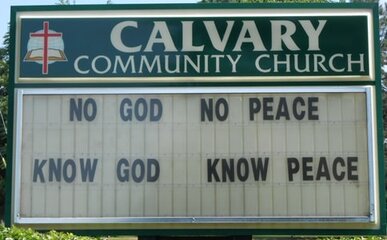
There is a phrase that has been said so many times over the years that it has become a cliche. That phrase can be seen in the picture to the right which shows a church marquee that says, “No God, no peace; know God, know peace.” This church is not the first to use this cliche, nor will they be the last.

It strikes me that this phrase is an overstatement at best and a falsehood at worst. My intention is not to call this church on the carpet but to examine what this phrase is saying and why I think in the end the phrase is not helpful.

The Overstatement

Church Cliche

I am in agreement that a relationship with God puts me in a better position to live at peace. To know the God of the universe and to know his plan for me should provide confidence that no matter what happens, my eternity is secure. My security is then based on my knowledge of who God is, not based on my own ability to change or grow.

Yet, we see that much of the experience of the saints over the years has been internal and external turmoil. Even a casual reading of the Psalms shows the Psalmist’s anguish at his own sin and the sin of others. I know men and women of God who live exemplary lives who are torn with family strife, financial stress and health issues. While they may experience joy in the midst of their trials, what they are experiencing would be difficult to describe as peace.

Jesus tells us “blessed are those who mourn.” It is right to be realistic about where we are; God has much work to do in us and in our world. The statement that a person will experience peace by entering into relationship with Jesus may not be immediately true. I believe that relationship puts us on the path to peace, but peace is not an immediate benefit.

The Fallacy

To the best of my knowledge I am in excellent health, yet I could have a cancer or some other medical condition that has not yet displayed symptoms. In other words I may be confident and at peace about my good health even though an unknown evil is working to bring my peace to an end. I may have a medical need about which I am unaware and I might be at peace in spite of my impending doom.

In the same way, non-believers who have never considered eternity and spiritual reality may be completely at peace in their physical comfort. To say that those who do not know God have no peace is not always true. There are those who don’t know God who are at peace with themselves and with others. They do not know any reason for discontent. Again I would point to the Psalms where the writer complains that those who do not know God are fat, dumb and happy while the saints are suffering.

The peace they experience without God is a transient one; it will not last. So it is our job to explain the temporary nature of that peace and make them aware of the large spiritual reality.

The Result

The church in the picture is trying to reach out to the community with this sign. I applaud them for this. Their motives give every appearance of being right in doing so. Yet to an increasing percentage of our society, this phrase will make no sense. It has become a cliche and perhaps should be abandoned.

What do you think? Is this phrase helpful in 2012 or has it become a cliche?

Filed Under: Bible Reflection Tagged With: Church, cliche

3 Common Discipleship Mistakes All-Too-Easy to Make

Posted on July 20, 2012 Written by Jeremy Postal Leave a Comment

This is a guest post by Jeremy Postal. See the biographical section below for more information about Jeremy and his ministry.

The idea of discipleship is a strange one.

ThreeIf there is one thing we can all agree on it is probably that “change is constant and it’s impacts us all.” Traffic patterns change, Facebook privacy policies change, the climate is changing, relationships change, jobs change, and no matter where we look change is always before us.

Interesting, though, rarely do we see change in ourselves or – for that matter – do we even want to change. We’re who we are and usually a little stubborn about it; I’m just trying to be me and you’re just trying to be you.

This is what makes discipleship a strange thing; most Christians recognize others’ need to be discipled and we point them to books, resources, and processes by which others can become better followers of Jesus. It actually feels really good to disciple other people; it just doesn’t feel so good to actually be a disciple ourselves.

Being a disciple requires change and it draws out tension in our lives, it fights against our stubbornness and it confronts the deepest parts of who we are. To be a disciple means we live in the struggle of loving and obeying God the Father while working out how to live well within the mess of our lives.

Change is hard. It’s hard to be a disciple, but there are ways to make it doable. Notice I don’t say easier – just doable.

MISTAKE #1: Lack of Process

It is easy to create discipleship process and programing for other people but much harder to build and commit to one for yourself. Make a plan for your discipleship and begin to walk it out. Ask:

  • Who is involved in my discipleship?
  • What does a discipleship community look like in my setting?
  • What areas of my life are most resistant to following Jesus?
  • What resources can serve in my discipleship?
  • What is the most intentional thing I/we can do to follow Jesus well?
  • How will I know when discipleship has slowed? What are the warning signs?
  • Is my process cyclical, does it have a rhythm, or is it linear with clear steps?

MISTAKE #2: Unbalanced Discipleship

Within discipleship circles it is easy to put all of our focus on one aspect of discipleship, damaging other vital areas of discipleship. For example, focusing on a vibrant inner prayer life while neglecting justice, mercy, and walking humbly with our God is an unhealthy, unhelpful, and incomplete life of discipleship. True, there will be seasons where more focus is given to certain areas but the heart of discipleship is to become more and more like Jesus. This is why discipleship is best practiced in community; a community has the resources to follow Jesus much better than any one individual Christian can.

MISTAKE #3: Discipleship Without Mission

The final mistake often made in discipleship processes is to forget about mission. Conversely, within much of the conversation of mission and missional church, the hard realities of discipleship have also been left out. The truth is that mission and discipleship are one-in-the-same, have been originated and initiated by God in our lives, and compliment each other as we work them out. As we are being discipled we are pushed into mission and as we are in mission we are conformed to the mind and heart of Christ. When we loose sight of this, we’ve lost sight of the whole thing.

And Jesus came and said to them, “All authority in heaven and on earth has been given to me. Go therefore and make disciples of all nations, baptizing them in the name of the Father and of the Son and of the Holy Spirit, teaching them to observe all that I have commanded you. And behold, I am with you always, to the end of the age.” –Matthew 28:18-20

Filed Under: Bible Reflection, Guest Post

Truth is an arrow and the gate is narrow

Posted on July 18, 2012 Written by Mark McIntyre 6 Comments

The Culture

Over the last week or so, I’ve tweeted about several stories regarding proposed or approved concessions that the “main line” denominations would make to the prevailing culture. For example is this one:

They wonder why people are leaving?: Rev. Emily C. Heath: The Religious Right (Side of History) http://t.co/mNxyCt69

— Mark McIntyre (@mhmcintyre) July 16, 2012

As Rev. Emily Heath writes in that article:

For Christians in the mainline Protestant denominations, this has been an interesting summer. First, the Presbyterian Church (USA) rejected an amendment that would have opened the church up to blessing same-sex marriages. Then, less than a week later, the Episcopal Church approved a new liturgy to bless same-sex unions and also affirmed the ministry of transgender clergy.

The PCUSA rejection of that amendment was a narrow victory for those who desire to stay true to Scripture.

The Truth

While Rev. Heath and others are euphoric over these monumental changes. I am reminded of Jesus’ words in Matthew 7:

“Enter through the narrow gate; for the gate is wide and the way is broad that leads to destruction, and there are many who enter through it. “For the gate is small and the way is narrow that leads to life, and there are few who find it.” (Matthew 7:13–14, NASB)

Truth is Narrow
Image via freefoto.com

Truth, is by its very nature narrow. The description of an object is always narrow as compared to what it is not. I have on my wrist a watch, it is not a hammer or a motorcycle or a puppy or a yacht. It is one thing and there are an infinite number of things it is not.

When the New Testament uses the word homosexual, the Greek word from which it is translated is a very graphic term which describes a sex act between men. You can work around this all that you want, but it is the homosexual act that is condemned. The word means one thing and no amount of wrangling of words can make it mean something different. The definition is narrow and specific.

Furthermore, Jesus himself tells us that marriage is between a man and a woman. According to Jesus, it is for the purpose of being married to a woman that a man will leave his father and mother.

Some would see support for homosexual union in an argument from silence because Jesus does not specifically speak against same sex pairing. Yet I would argue that the silence cuts the other way because Jesus specifically identifies a union between a man and a woman as the relationship that God ordains and God blesses. Nowhere can you find any such blessing for a homosexual union. So the argument that Jesus was silent on homosexuality is a sham.

The definition of marriage is narrow. I understand that for those with same sex attraction, this is very difficult. Yet, the difficulty does not relieve us of the burden of proclaiming the truth.

All sin is condemned in Scripture. For example, the Bible condemns religious pride. Those of us who have grown up in the church can look down on others who have less knowledge of Scripture and Christian principles. Scripture condemns this pride and I am wrong when I practice it. When I am proud, no excuse or explanation will make that pride less wrong.

We cannot lightly set aside the clear teaching of Scripture just because we have a desire and a  proclivity toward a certain behavior. Whether it be pride or homosexuality, we cannot aquiesce into acceptance no matter how much pressure there is from inside and outside the church.

The Gate

As Bob Dylan so eloquently tells us, “Truth is an arrow and the gate is narrow that it passes through.”

The Truth hurts all of us, but the wound is ultimately for our benefit if we are willing to yield.

Filed Under: Bible Reflection, Christianity and Culture Tagged With: Church, Culture, homosexuality, Truth

  • « Previous Page
  • 1
  • …
  • 108
  • 109
  • 110
  • 111
  • 112
  • …
  • 150
  • Next Page »

Follow Attempts at Honesty

Honesty in your Inbox

Post Series

  • Westminster Shorter Catechism Series
  • Sermon on the Mount Series
January 2026
SMTWTFS
 123
45678910
11121314151617
18192021222324
25262728293031
« Dec    

Categories

Archives

Blogger Grid
Follow me on Blogarama

Copyright © 2026 · Focus Pro Theme on Genesis Framework · WordPress · Log in