• Home
  • About This Blog
  • Contact Me
  • Subscribe
  • Comment Policy

Attempts at Honesty

Reflections on the interplay of the Bible and Culture

  • Westminster Shorter Catechism Series
  • Sermon on the Mount Series
Home 2013 Archives for April 2013

Archives for April 2013

How to keep Chreasters coming back

Posted on April 8, 2013 Written by Mark McIntyre 3 Comments

Like many of my high school term papers, this post is about two weeks late. My timing isn’t great, but recent discussion about Chreasters has kept this topic is on my mind.

Chreaster Dads
Used by permission – www.insertimg.com – Click to enlarge

We joke about Chreasters, those who show up for church on Christmas and Easter. A recent Christian Post article about how to keep them coming back gave some ideas as to how to deal with a surge of people who decide to visit church on Easter. While Christmas and Easter are two seasons where the church is more likely to encounter visitors, we should be prepared to welcome visitors on any Sunday throughout the year.

The article makes the point that we should not rely on gimmicks to get visitors interested in coming back to the church. We should be prepared to minister to those who are curious or those who are brought to church by a family member. If we are relying on gimmicks and entertainment, eventually we will run out of stuff to keep them interested. So caged lions and special music are not the answer.

One question that should be considered is why are they Chreasters in the first place. Ask yourself “who are these people and how would Jesus minister to them?”

As I see it, the reason that people do not attend church is because they do not perceive a need for it. They have not yet considered the big questions in life, or they have considered them and do not see a need for God to be a factor in determining their response to those questions. Church is not a priority because there is no perceived benefit.

When I read the gospels, I see that Jesus often raised questions to get his hearers to consider ideas that were previously ignored. In John 4:16, Jesus suggested to a woman that she call her husband to the well. This led to a discussion of the woman’s marital history and her need for the Messiah. One chapter earlier, Jesus told a Pharisee that he must be born again. Jesus cut right to the heart. In both cases Jesus challenged both the object and the means of worship.

We don’t need church, we need Jesus. Church is a place where we should see Jesus in others and be encouraged in our own relationship with Him. Attending church is a need for me, but it is a secondary need, my primary need is for Jesus. We must challenge visitors toward an eternal perspective. We must, like Jesus, bring people face-to-face with their ultimate needs. We have to offer more than coping skills.

As the article points out, there are things we can do to make guests feel welcome and comfortable. Ed Stetzer reminds us in the article that it is a little like getting ready for house guests. When we have house guests, we tell them where the towels are, which bathroom to use and all of the other information required to make them comfortable.

We should do the same at church. When guests see members walking around with coffee cups, it would be a good thing to show visitors where to get coffee. Having a clearly identified place for them to ask questions is also helpful. The goal in all of this is to remove barriers that prevent people from hearing the good news of Jesus Christ.

On Christmas and Easter, the church should be doing what it should be doing every Sunday which is point people to Jesus as their primary need. Visitors don’t need the music to be perfect. Not every sermon is going to be a pinnacle of oratory. Visitors will encounter flawed people because that is what we are. But they should encounter flawed people who have learned how to love and who radiate the joy that can be found in Christ.

If people see Jesus in us, if they hear Jesus proclaimed in the sermon, if they hear Jesus worshiped in the music, God can use that visit to stir up their hearts to recognize their hunger that only Jesus can fill.

People don’t need church, they need Jesus. Church is the delivery vehicle, not the cargo.

Filed Under: Christianity and Culture Tagged With: Chreaster, Christmas, Church, Easter, Jesus

Don’t add or subtract

Posted on April 5, 2013 Written by Mark McIntyre 10 Comments

 “You shall not add to the word that I command you, nor take from it, that you may keep the commandments of the Lord your God that I command you.” (Deuteronomy 4:2, ESV)

We are told that we are not to add or subtract from what God commanded of the Nation of Israel through Moses.

Jesus gives us his viewpoint on the Old Testament when he said,

“For truly, I say to you, until heaven and earth pass away, not an iota, not a dot, will pass from the Law until all is accomplished.” (Matthew 5:18, ESV)

From these statements, it should be obvious that we should not add or subtract from what is written in Scripture. Do we add and subtract? I think that we do.

Adding to Scripture

Add or subtract

We add to Scripture when we make some sins worse than others. For example, the church has a history of elevating sexual sin to be worse than more common sins like pride. I have met many prideful Christians who find excuse for their pride while condemning others.

We add to Scripture when we call sin what the Bible does not prohibit. For example, some churches condemn all alcohol use as sin. I understand that alcohol has had devastating effects on families and individuals and that some are prone to addiction, but we must be careful in saying more than Scripture says.

We add to Scripture when we take a hard stance of issues that are unclear in Scripture under the guise of denominational “distinctives.” For example, Scripture gives hints about the events surrounding Jesus’ return, but we are not given a timeline or order of events. It it OK to make guesses about the events, but they remain guesses. To stand on one interpretation as the only possible correct interpretation is divisive and unwise.

Subtracting from Scripture

We subtract from Scripture when we explain away clear statements in the Bible. One example is the current debate over the definition of marriage. There are some in the church who have felt the freedom to deviate from the definition of marriage that God gave us in Scripture under the guise of “inclusiveness.” We should be loving to everyone, but we do not have the freedom to revise what God has proscribed.

We also subtract from Scripture when we ignore its teaching. For example, Paul tells us to be angry but do not sin (Eph 4:26). Those who justify their inappropriate anger by saying, “that’s just the way I’m wired” or “that’s just how my family was” are subtracting from Scripture.

We subtract from Scripture when we ignore or forget the promises that are made to us. Jesus tells us “I am with you always, even to the end of the age” (Matt. 28:20). Yet, I often find myself stressing over the details of life. Remembering that Jesus is with me should change my behavior.

Conclusion

The bottom line is that we add in the area of external sins by adding rules above and beyond Scripture. We subtract in the areas of internal sins by making excuses for our own behavior. We like to declare what others are doing is sin while excusing our own failures. I see this tendency in myself and my observation of others seems to prove that this is a universal tendency.

The goal is not external conformity to a set of rules. The goal is to have a heart yielded to God and willing to do what he commands.

I find great comfort in my favorite prayer in Scripture, “I do believe; help my unbelief.” (Mark 9:24)

Filed Under: Bible Reflection Tagged With: add, Bible, command, subtract

Chesterton on original sin

Posted on April 3, 2013 Written by Mark McIntyre 1 Comment

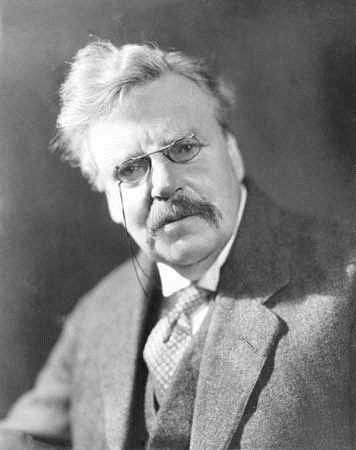
G. K. Chesterton“Modern masters of science are much impressed with the need of beginning all inquiry with a fact. The ancient masters of religion were quite equally impressed with that necessity. They began with the fact of sin – a fact as practical as potatoes. Whether or no man could be washed in miraculous waters, there was no doubt at any rate that he wanted washing. But certain religious leaders in London, not mere materialists, have begun in our day not to deny the highly disputable water, but to deny the indisputable dirt. Certain new theologians dispute original sin, which is the only part of Christian theology which can really be proved. Some followers of the Reverend R. J. Campbell, in their almost too fastidious spirituality, admit divine sinlessness, which they cannot see even in their dreams. But they essentially deny human sin, which they can see in the street. The strongest saints and the strongest sceptics alike took positive evil as the starting-point of their argument. If it be true (as it certainly is) that a man can feel exquisite happiness in skinning a cat, then the religious philospher can only draw one of two deductions. He must either deny the existence of God, as all atheists do; or must deny the present union between God and man, as all Christians do. The new theologians seem to think it a highly rationalistic solution to deny the cat.”

G. K. Chesterton in Orthodoxy

Filed Under: Quotation Tagged With: evil, original, Sin

Judging the judge: You cannot have it both ways

Posted on April 1, 2013 Written by Mark McIntyre 9 Comments

JudgeOne of the objections raised against Christianity is that the God of the Bible is a vengeful deity who commanded Israel to practice genocide as they conquered the land of Canaan.

As a Christian, I would be the first to admit that some of what I read in the Old Testament (OT) makes me uncomfortable. There are things in the Bible that offend my 20th Century sensibilities. Yet we must look at the context of that command and understand it in its historical setting.

In the instances where Israel was commanded to wipe out an entire population, that command resulted from the evil that was being practiced by the soon to be conquered people. One of the most detestable practices was that of child sacrifice. God chose to eradicate the people to contain the evil.

On the other hand, another argument against belief in God is based on God’s apparent inability to contain or eliminate evil. People struggle with seeing the love of God when bad things have happened in their own lives or in the lives of others. The question is framed something like this: “how do you expect me to believe in a God that would allow the Holocaust to take place?”

But we cannot have it both ways. We cannot on the one hand complain when God steps in to eliminate evil and then complain when he does not. We cannot be the final arbiter of determining the justice (or lack thereof) of God.

The original attack on God’s credibility came in Genesis 3 when Satan asked the question of Eve, “did God really say?” There is always a danger when we assume the authority to stand in judgment of God.

God created humans as moral agents with the ability to choose well or choose badly. That ability to choose has not been rescinded and we get it wrong much of the time. If God changed the world so that none of us could choose to do wrong, we would all then become automatons.

The fact is that I choose badly every day. There is not a day that goes by where I do not have an inappropriate thought, say something that is hurtful to others or fail in some other way.

This does not eliminate the so-called “problem of evil.” We will never fully understand how the justice and love of God can be simultaneously if effect. Depending on our point of view, we will often be uncomfortable with what God allows or doesn’t allow.

So the question then becomes, am I willing to allow God to vanquish the evil in my own heart? Am I willing to admit my own finitude? Am I willing to worship a God who sometimes makes me uncomfortable? Am I willing to allow God to be the judge and trust that he will get it right?

Are you?

Filed Under: Bible Reflection Tagged With: evil, judge, judgment

  • « Previous Page
  • 1
  • 2

Follow Attempts at Honesty

Honesty in your Inbox

Post Series

  • Westminster Shorter Catechism Series
  • Sermon on the Mount Series
April 2013
SMTWTFS
 123456
78910111213
14151617181920
21222324252627
282930 
« Mar   May »

Categories

Archives

Blogger Grid
Follow me on Blogarama

Copyright © 2025 · Focus Pro Theme on Genesis Framework · WordPress · Log in