• Home
  • About This Blog
  • Contact Me
  • Subscribe
  • Comment Policy

Attempts at Honesty

Reflections on the interplay of the Bible and Culture

  • Westminster Shorter Catechism Series
  • Sermon on the Mount Series
Home Archives for Bible Reflection

Going after false idols

Posted on April 29, 2013 Written by Mark McIntyre 5 Comments

Too often the church takes on aspects of the surrounding culture and is damaged as a result. I believe this happens when we lose sight of the nature of Christianity. It my be a worn phrase, but still true that Christianity is a relationship and not a religion. This has been true of the worship of God since the beginning.

The Nation of Israel lost sight of this fact and fell into error. We read in 2 Kings 17:15:

“They despised his statutes and his covenant that he made with their fathers and the warnings that he gave them. They went after false idols and became false, and they followed the nations that were around them, concerning whom the Lord had commanded them that they should not do like them.” (ESV)

Happy Meal ToysThere is nothing wrong with taking aspects of the culture that can be redeemed by the gospel and using those to communicate eternal truth. There is nothing inherently “spiritual” in being 10 to 50 years behind the culture in musical taste. God does not like organs any more or less than guitars. Music in any style can be used as a medium to convey the good news of Jesus Christ.

Dress is another area that has often been a source of contention in the church. My normal Sunday dress consists of Converse All Stars, blue jeans, and some form of a button down shirt. In some churches, this would be considered irreverent. Yet, this is how much of the surrounding culture in my area dresses. We should not allow our dress to distract someone away from our message of hope.

Dress, music and many of the other battleground issues in the church do not constitute going after false idols. The problem of Israel was not that they emulated the surrounding nations in their cultural expressions of dress or music.

The problem was that they forgot the source of their blessing and national existence. They turned away from the God who brought them out of Egypt and made them a nation. They hedged their bet by also worshiping the gods of the Canaanites.

When we look to anything other than God for our existence and blessing then we are following in the steps of the Nation of Israel in following after false idols.

If we think that methods or programs will grow the church we are going after false idols. When we think that altering our message will grow the church, we are following after false idols. When we think that the beauty of our campus will grow the church, we are following after false idols.

Jesus told Peter that He would build the Church and this remains true today. In the end, if we want the church to be strong and to grow, it must be entirely focused on Jesus Christ and the message of salvation that can be found in his birth, ministry, death and resurrection. It is upon this rock, this confession, that the church will be built.

Too often the church seeks acceptance by becoming like the surrounding culture and ends up making inappropriate compromises. When we do this, we are trading what is of value for that which holds no value. It is like trading a bar of gold for a used Happy Meal toy.
Filed Under: Bible Reflection Tagged With: Church, Happy Meal, idol, relationship

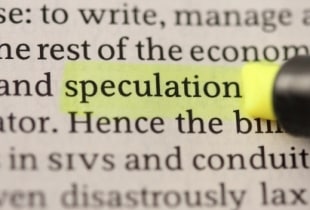
Speculation in the Evangelical community

Posted on April 19, 2013 Written by Mark McIntyre 4 Comments

Speculation“As I urged you when I was going to Macedonia, remain at Ephesus so that you may charge certain persons not to teach any different doctrine, nor to devote themselves to myths and endless genealogies, which promote speculations rather than the stewardship from God that is by faith.” (1 Timothy 1:3–4, ESV)

There are two categories of those who Paul condemns in these verses. The first is those to teach a different doctrine. The second are those who promote speculations (ESV) or controversies (NIV).

A different doctrine

In the first category I would put organizations like the LDS Church and the Watchtower Society. What sets them apart from Scripture is their teaching on the person of Jesus Christ and the means of salvation. They clearly teach a different doctrine than the catholic (universal) church has for the last two thousand years. When the teachings of these organizations are compared to Scripture, it becomes clear that their doctrine is different than what Scripture presents.

Promoting speculation

Those who promote speculation are often less obvious. We must be willing to look inside the Evangelical community with honesty to identify when we have begun to promote speculation.

For example, the Book of Revelation is full of symbols. It would have been so much easier if Jesus just gave us a timeline and provided specific dates and descriptions of events yet to happen. He did not. Therefore, we must look at the symbols to see what lessons are in them for us.

The danger in this is that depending on presuppositions we can come to different understandings of what the symbols mean. The fact that they are symbols that can be interpreted differently should lead us to caution in declaring that our understanding is the only right interpretation. Yet, there are many churches who make such a declaration.

Let us stand firm on the teaching in Scripture that is clear. About the meaning of the birth, ministry, death and resurrection of Jesus Christ we can be confident in our understanding. On those issues that are not clear or are open for interpretation, we mush allow for difference of opinion and be wary of those who promote only one possible understanding.

I am reminded of the phrase attributed to Rupertus Meldenius:

In essentials unity
In non-essentials liberty
And in all things charity

Filed Under: Bible Reflection Tagged With: Bible, genealogy, Gospel, myth, sepculation

On rationalization of sin

Posted on April 17, 2013 Written by Mark McIntyre 9 Comments

Gold BarsThis morning I read the story of Achan whose sin caused the defeat of Israel when they went up against Ai. This story can be found in Joshua 7:16-26.

As a 21st Century American, I bristle when I read this story. I want to tell God that it was such a little sin. It seems natural that Achan should desire the goods that he confiscated. He had a momentary lapse of judgment and for that he and his entire family got stoned?

The danger of grace is that we can take Grace for granted and lose perspective on how serious God is about sin. I once heard a definition of sin as man playing God in his own life. By this definition, anything that I do that is contrary to what God expects is a sin.

I observe in myself and I believe I observe in others that humans have an almost infinite capacity to rationalize sin and make it sound legitimate. In this we follow our first parents in their response to the very first sin. Adam blamed Eve (and God) and Eve blamed the serpent.

When confronted with sin, like Adam, I want to find a way to say that it is not my fault. But it is my fault, the fact is that I choose to disobey.

The fix for this problem is not a legalistic system of do’s and don’ts. Legalism exacerbates the problem by focusing attention on the symptoms rather than the disease. The disease is a heart that is unwilling to yield to God. Legalism does nothing to soften the damaged heart and bring it in submission to God.

Legalism produces two undesirable effects. For those who are successful at keeping the rules, pride sets in which makes the heart even more unresponsive to God. For those who recognize their inability to keep the rules, an inappropriate sense of unworthiness can set in. This sense of unworthiness can then trigger rejection of the very God who gives them worth.

The sin of Achan was not that he desired the loot. The sin was that he did not desire God more than the loot. As C. S. Lewis points out, the problem was not that Achan’s desires were too strong, they were weak and focused on the wrong thing.

We presume upon Grace when we rationalize sin. The fact that we don’t end up under a heap of stones is not because we don’t deserve that heap. I share in the sin of Achan and that is why this story makes me feel uncomfortable.

Filed Under: Bible Reflection Tagged With: Achan, covet, desire, gold, Sin

Don’t add or subtract

Posted on April 5, 2013 Written by Mark McIntyre 10 Comments

 “You shall not add to the word that I command you, nor take from it, that you may keep the commandments of the Lord your God that I command you.” (Deuteronomy 4:2, ESV)

We are told that we are not to add or subtract from what God commanded of the Nation of Israel through Moses.

Jesus gives us his viewpoint on the Old Testament when he said,

“For truly, I say to you, until heaven and earth pass away, not an iota, not a dot, will pass from the Law until all is accomplished.” (Matthew 5:18, ESV)

From these statements, it should be obvious that we should not add or subtract from what is written in Scripture. Do we add and subtract? I think that we do.

Adding to Scripture

Add or subtract

We add to Scripture when we make some sins worse than others. For example, the church has a history of elevating sexual sin to be worse than more common sins like pride. I have met many prideful Christians who find excuse for their pride while condemning others.

We add to Scripture when we call sin what the Bible does not prohibit. For example, some churches condemn all alcohol use as sin. I understand that alcohol has had devastating effects on families and individuals and that some are prone to addiction, but we must be careful in saying more than Scripture says.

We add to Scripture when we take a hard stance of issues that are unclear in Scripture under the guise of denominational “distinctives.” For example, Scripture gives hints about the events surrounding Jesus’ return, but we are not given a timeline or order of events. It it OK to make guesses about the events, but they remain guesses. To stand on one interpretation as the only possible correct interpretation is divisive and unwise.

Subtracting from Scripture

We subtract from Scripture when we explain away clear statements in the Bible. One example is the current debate over the definition of marriage. There are some in the church who have felt the freedom to deviate from the definition of marriage that God gave us in Scripture under the guise of “inclusiveness.” We should be loving to everyone, but we do not have the freedom to revise what God has proscribed.

We also subtract from Scripture when we ignore its teaching. For example, Paul tells us to be angry but do not sin (Eph 4:26). Those who justify their inappropriate anger by saying, “that’s just the way I’m wired” or “that’s just how my family was” are subtracting from Scripture.

We subtract from Scripture when we ignore or forget the promises that are made to us. Jesus tells us “I am with you always, even to the end of the age” (Matt. 28:20). Yet, I often find myself stressing over the details of life. Remembering that Jesus is with me should change my behavior.

Conclusion

The bottom line is that we add in the area of external sins by adding rules above and beyond Scripture. We subtract in the areas of internal sins by making excuses for our own behavior. We like to declare what others are doing is sin while excusing our own failures. I see this tendency in myself and my observation of others seems to prove that this is a universal tendency.

The goal is not external conformity to a set of rules. The goal is to have a heart yielded to God and willing to do what he commands.

I find great comfort in my favorite prayer in Scripture, “I do believe; help my unbelief.” (Mark 9:24)

Filed Under: Bible Reflection Tagged With: add, Bible, command, subtract

  • « Previous Page
  • 1
  • …
  • 97
  • 98
  • 99
  • 100
  • 101
  • …
  • 150
  • Next Page »

Follow Attempts at Honesty

Honesty in your Inbox

Post Series

  • Westminster Shorter Catechism Series
  • Sermon on the Mount Series
January 2026
SMTWTFS
 123
45678910
11121314151617
18192021222324
25262728293031
« Dec    

Categories

Archives

Blogger Grid
Follow me on Blogarama

Copyright © 2026 · Focus Pro Theme on Genesis Framework · WordPress · Log in